
The following is an April 10, 2026, response to the Request for Information on how the U.S. Senate Health, Education, Labor, and Pensions (HELP) Committee can address college sports issues.
Delivered via email to opportunitiesforathletes@help.senate.gov
The Honorable Bill Cassidy Chairman Senate Health, Education, Labor, and Pensions (HELP) Committee
Dear Chairman Cassidy,
The Knight Commission on Intercollegiate Athletics is an independent group whose purpose is to develop, promote, and lead transformational change that prioritizes the education, health, safety, and success of college athletes. The Commission has a legacy of influencing NCAA policies that led to record-high graduation rates of Division I athletes, reshaped financial incentives impacting education and gender equity, and advanced athlete representation. Its work also provides financial transparency for college sports and influential research that guides national policy and leadership decisions.
A two-page document detailing our policy priorities is attached. This document addresses several of the important questions posed in the request for information about athlete eligibility and transfer rules, athlete agent issues, and how the college sports ecosystem can balance providing broad opportunities in this new era of athlete compensation. We have extensive research and additional information available about the proposed solutions should you be interested in learning more.
Below, we address two additional specific questions in the request for information. The first question relates to the HELP Committee’s important jurisdiction over Title IX. This issue should be urgently addressed, given annual financial reporting that occurs after the end of each institution’s fiscal year on June 30.
HOW DOES REVENUE SHARING UNDER THE HOUSE SETTLEMENT AFFECT SCHOOLS’ ABILITY TO COMPLY WITH TITLE IX REQUIREMENTS?
The Knight Commission believes that institutions must be mandated to disclose “Institutional NIL Revenue Share” payments separately by men’s and women’s teams overall on both the NCAA’s Membership Financial Reporting Summary (MFRS) and the Equity in Athletics Disclosure Act (EADA) report collected by the Department of Education. These new athlete payments are institutionally provided funds and this requirement for reporting would align with the current requirement that institutions report the total amount of athletics scholarships provided separately to men’s and women’s teams overall.
The reporting requirement for the new “Institutional NIL Revenue Share” spending category is not yet clear since neither the NCAA nor the Department of Education have released instructions for completing the required forms at the end of this fiscal year on June 30.
Background
The NCAA currently requires each Division I institution to submit a Membership Financial Reporting Summary (MFRS) report at the close of each fiscal year. Fiscal year 2025 reports were the first to include an expense category titled “Institutional NIL Revenue Share,” but the instructions allowed institutions to report the amounts “not allocated by gender.” Only a few institutions were permitted to have these types of expenses in the 2025 academic fiscal year since a few state laws allowed their institutions to provide NIL compensation directly to college athletes. With the House v. NCAA settlement being implemented beginning July 1, 2025, all Division I institutions that
decided to provide the newly permitted institutional payments to athletes will have spending in this new category going forward. Despite the NCAA creating this new expense category on the MFRS report, there is no current requirement that institutions report these institutional financial payment amounts to be broken down by gender in the same way institutions are required to report institutional financial assistance through athletics scholarships. Mandating accurate financial reporting for all athletically related financial assistance made by institutions ensures that Title IX compliance is appropriately monitored in this new era.
In Executive Order 14400 (Urgent National Action to Save College Sports, April 3, 2026), President Trump directed the Department of Education to take appropriate action to require regular reporting of “the total amount of money spent on athletically related student aid or other payments, separately for men’s and women’s teams overall.” We urge the committee to ensure that this reporting includes Institutional NIL Revenue Share payments for men’s and women’s teams, and that the Department of Education provide clear guidance to institutions on this reporting requirement as expeditiously as possible.
HOW ARE REVENUE-SHARING PAYMENTS WORKING FOR TODAY’S STUDENT-ATHLETES AND SCHOOLS? TO WHAT DEGREE DOES REVENUE SHARING REACH ALL STUDENTS PLAYING THE REVENUE SPORT? HOW WOULD THIS ARRANGEMENT BE AFFECTED IF STUDENTS WERE CLASSIFIED AS EMPLOYEES?
Our responses to these questions aim to correct common misconceptions about how “Institutional NIL revenue sharing” works:
-
- College athletes, regardless of the revenue their sport does or does not generate, are eligible to receive “NIL compensation” and “revenue-sharing” payments directly from their institution. Each institution operates under its own discretion to decide which athletes receive these enhanced benefits. For example, even if a sport, like men’s cross-country, does not generate surplus revenue, an institution can still provide “revenue-sharing” payments to athletes on that team. To this point, in its FY2025 MFRS report, one Power 4 institution reported its specific revenue-sharing expenditures by sport and gender. The institution distributed more than $2 million to athletes in seven sports other than men’s basketball and football.
- The revenues that define the institutional “athlete revenue-sharing cap” pursuant to the House settlement are not held in a separate account for disbursement. As mentioned above, institutions have the discretion to provide athletes in any sport with “Institutional NIL Revenue Share” payments up to the aggregate institutional cap amount. In some cases, institutions may use institutional funding and/or student fees as the revenue source for “Institutional NIL Revenue-Share” payments made to athletes.
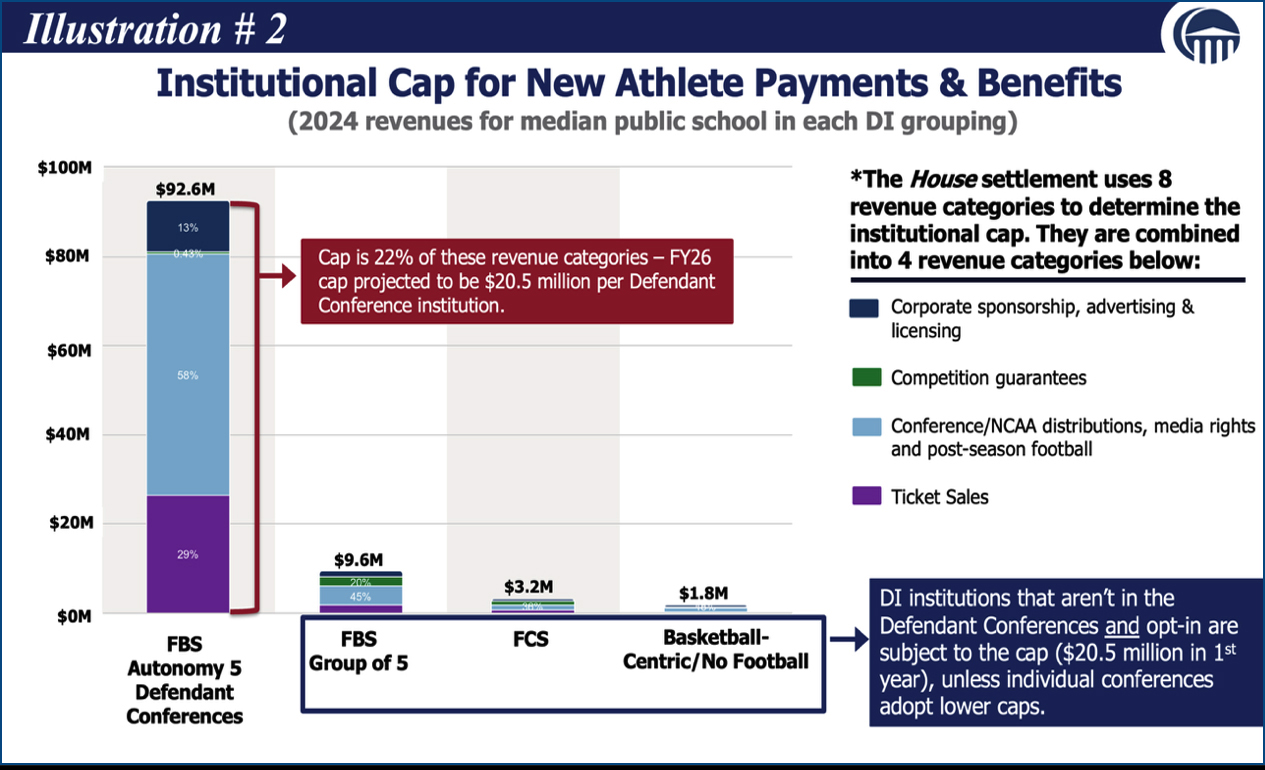
The graphs below illustrate how the athlete revenue-sharing cap formula is calculated and how the specific revenue sources significantly differ across Division I institutions.
In Illustration # 1, the categories used to calculate the institutional athlete revenuesharing cap are shown. Only the revenues from the five Defendant Conferences (Atlantic Coast Conference, Big Ten, Big 12, Pac-12, and Southeastern Conference) are used, and the cap is calculated by determining 22% of the average of those revenue categories. [Note: For this illustration, actual revenues for the median public school in this group are used.]
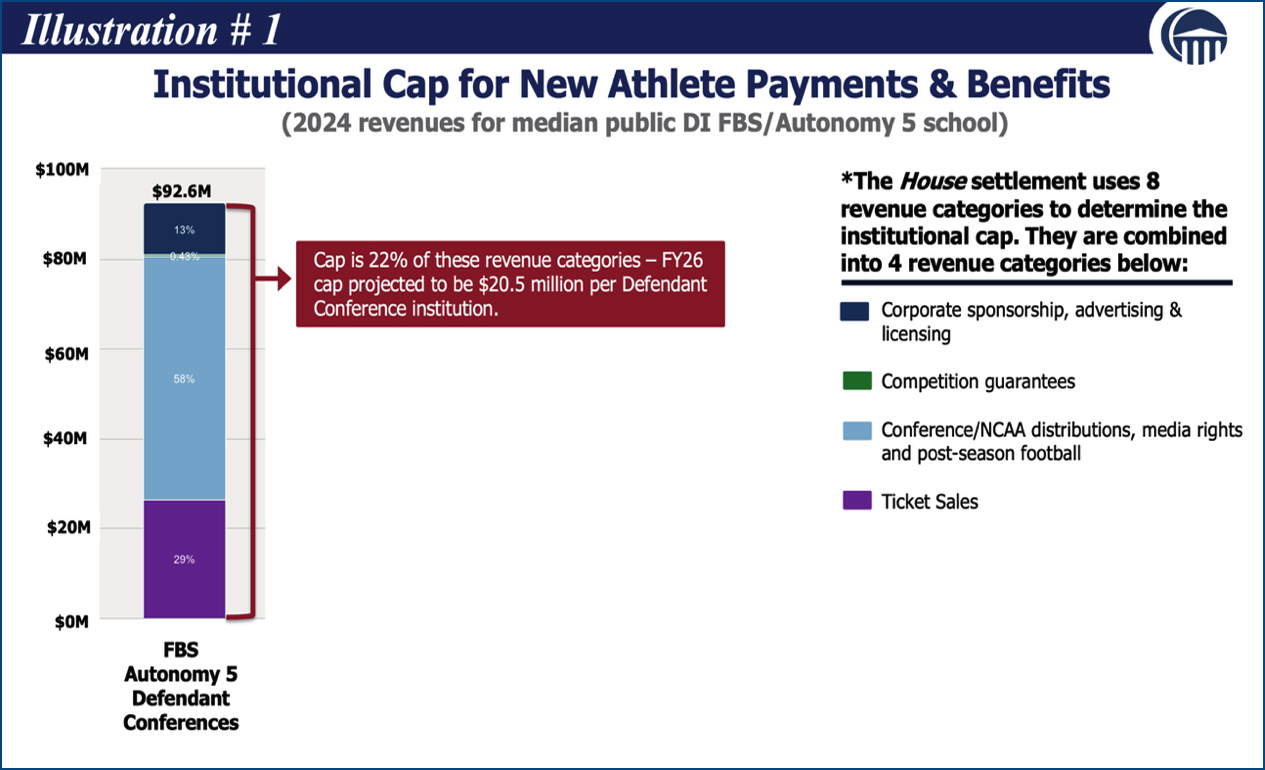
Illustration # 2 displays how much revenue from those same categories the median institution in the three other Division I groupings generates. As the illustration shows, the median institutions in these groups generate significantly less revenue in those categories. This means that institutions in those groupings, if they decide to “revenueshare” with their athletes, could be subsidizing athlete compensation with institutional funds and/or student fees.
In order to promote transparency and financial accountability, institutions should be mandated to report “Institutional NIL Revenue Share” payments – regardless of the source of those funds – separately for men’s and women’s teams overall on both the NCAA MFRS reports and the Equity in Athletics Disclosure Act (EADA) reports collected by the Department of Education.
Finally, the Knight Commission has not taken a position on employee classification for college athletes. The Commission provided funding for research on this issue to the FCS/DIAAA athletics directors associations. This research can be found here.
We hope this information is helpful and we look forward to serving as a resource to the Committee as it continues its thoughtful consideration of legislative solutions.
Sincerely,
Amy Privette Perko (signed)
CEO, Knight Commission on Intercollegiate Athletics
Read the full letter and Knight Commission 2026 Priorities attachment here: Knight Commission Letter to HELP Committee – April 10, 2026