
National Harbor, MD – The Knight Commission on Intercollegiate Athletics today announced its support of the NCAA’s proposed age-based, five-year eligibility concept, as it aligns with the standard four- or five-year college experience for full-time students. The Knight Commission also supports a change to the current transfer rules to set reasonable limits on athlete transfers to promote academic continuity and degree completion.
The Commission took these actions at its May 13 meeting after hearing university presidents and other college sports leaders express their views of the most pressing issues and solutions to achieve stability and fairness in NCAA Division I, along with the reasons for their continued calls for federal legislation.
 Knight Commission Co-Chair Len Elmore said, “Today we heard leaders emphasize that two of the most pressing issues contributing to instability in college sports are inconsistent eligibility periods for some athletes and high transfer rates that are often accompanied by illegal tampering and/or athlete exploitation by agents. It is untenable for some athletes to have six or seven years of eligibility while most compete within the standard four- or five-year college student experience. Allowing unlimited transfers with immediate eligibility has also created an unhealthy environment for athletes, universities, and college sports overall. While many problems in college sports require solutions, addressing these two acute issues is most urgent and broadly supported.”
In a national survey of campus leaders conducted in partnership with Elon University Poll last fall, more than 8 in 10 leaders opposed the current transfer rules that provide athletes with immediate eligibility with each transfer.
Co-Chair Elmore said, “To enable consistent enforcement of athlete eligibility rules, the Knight Commission supports federal legislation that gives a national governing entity the legal authority – and limited, conditional antitrust immunity – to set college athlete eligibility rules and reasonable limits on college athlete transfers. These rules and limits should be linked to the educational purpose of college sports by promoting academic continuity and degree completion.”
Status and Reactions to Proposed Federal Legislation
In a panel discussion, Rob Mangas, Greenberg Traurig federal government law and policy attorney, reviewed the state of proposed federal legislation. The prospect of such a measure reaching the U.S. House floor has increased with a revised version of the SCORE Act being released this week through the chamber’s Rules Committee. Mangas said negotiations for a Senate bill are continuing, led by Commerce Committee chair Ted Cruz (R-Tex.) and the panel’s top Democrat, Maria Cantwell (Wash.).
Mangas said there is “near consensus” among legislators from both parties on several issues: an age-based, five-year model for eligibility; allowing athletes, with some exceptions, to transfer only once as undergraduates with immediate eligibility and once again upon graduation; registration requirements and regulations for agents; legal enshrinement of athletes’ ability to make money from their name, image and likeness; protections for women’s and non-revenue sports; and coverage of athletes’ health and safety.
 Big East Conference Commissioner Val Ackerman said of changing the current landscape of unlimited transfers: “We … believe that only Congress can empower the NCAA to enforce common-sense rules consistent with educational values, like permitting a return to one-time immediate eligibility transfers to prevent bidding wars and sustain graduation rates … and sanctioning the NCAA’s recently proposed age-based eligibility rule.”
Virginia Tech President Tim Sands, who also serves as Chair of the NCAA Division I Board of Directors, reinforced the connection between college sports and the academic mission, “…if we allow unlimited transfers for reasons that have nothing to do with the pursuit of a degree, we have relinquished the student-athlete model.”
 Sam Edwards, a former Michigan State football athlete and current member of the NCAA Division I Board of Directors, said federally mandated regulation of agents also will improve the college sports environment. Edwards said, “The predatory behavior of the agents … if we solve that issue, I think the tampering issue and the transfer portal issue will fall into place for the most part.”
NCAA Age-Based, Five-year Eligibility Concept Update
NCAA Vice President of Governance and Member Services Jenn Fraser said the NCAA’s proposed age-based, five-year eligibility period that provides five years from the date of an athlete’s high school graduation or 19th birthday, whichever comes first, to compete in NCAA Division I sports remains in “concept” form.
“No date for the action on a proposal has been established as of yet,” Fraser said. “The committees do have meetings on the books in the next few months. And as they go about answering these questions about implementation and specifying what a future eligibility construct will be, information will continue to be released publicly, as well as a date for legislative action.”
The proposed concept also would eliminate all redshirts and medical waivers, providing only very limited exceptions, which Fraser said will be discussed at NCAA governance meetings later this month.
Fraser did clarify that athletes who completed their athletic eligibility during the 2025-26 school year will not be afforded additional eligibility in the new model, if it is adopted, unless there was a previously applied waiver.
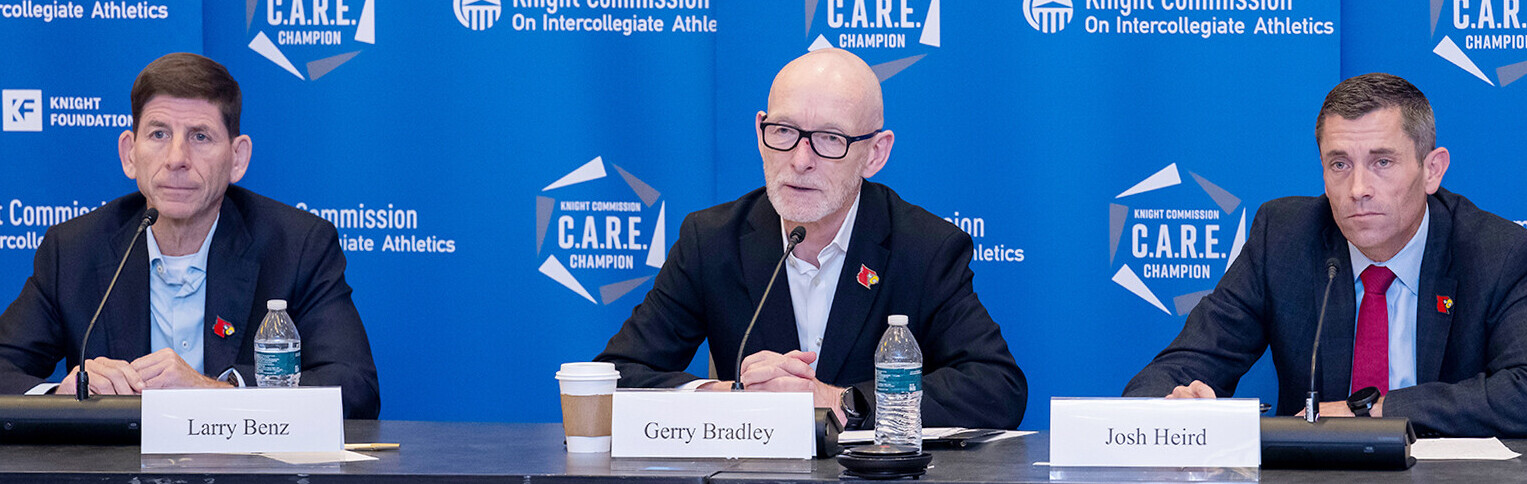 University of Louisville Leaders Outline Proposed Reforms
The University of Louisville’s Board of Trustees Chair Dr. Laurence N. Benz, President Gerry Bradley, and Vice President and Director of Athletics Josh Heird spoke about a series of white papers they recently co-authored concerning their views on the primary issues facing college sports and possible solutions.
They discussed four priorities:
- A governing body that “can actually govern,” said Benz, whether it’s a congressionally chartered entity or the NCAA with some degree of antitrust protection. “Voluntary frameworks and opt-in settlements are not governance,” he said. Heird added, “I truly believe that congressional intervention is the only way that we can get (college athletics) back to where it needs to be.”
- What Benz termed a hard, enforceable spending cap, potentially covering all forms of athletics spending. Heird added: “And, yes, it should include a discussion around caps on compensation for all involved: student-athletes, coaches and administrators.”
- Amendment of the Sports Broadcasting Act of 1961 to “to give colleges an option – not the mandate, but the option – to negotiate media rights collectively,” Benz said.
- Student-athletes must be at the center of all policymaking. One way to accomplish this is more athlete involvement in college sports governance, according to Heird. “We must create an opportunity for the group of people most impacted by these decisions to have a voice, and not just football and basketball student-athletes … A representative sample of voices must be created to help solve our current issues.”
Knight Commission CEO Amy Privette Perko said, “Leaders today emphasized what we continue to hear – the current athletics expense trends are not sustainable. Unfortunately, teams are being dropped and opportunities are being lost. Providing opportunities to college athletes beyond football and basketball is a core value of college sports. Our Commission has long proposed solutions to preserve these opportunities like more regional competition schedules and increasing national financial incentives to institutions that provide more opportunities. It’s urgent that these solutions be implemented.”
New Knight Commission Members
New Knight Commission members David L. Foster and Oliver Luck participated in the meeting. A release about the new members can be found here.
###
About the Knight Commission on Intercollegiate Athletics
The Knight Commission on Intercollegiate Athletics is an independent group whose purpose is to develop, promote and lead transformational change that prioritizes the education, health, safety and success of college athletes. The Commission has a legacy of influencing NCAA policies that led to record-high graduation rates of Division I athletes, reshaped financial incentives impacting education and gender equity, and advanced athlete representation. Its work also provides financial transparency for college sports and influential research that guides national policy and leadership decisions. The Commission is funded by the John S. and James L. Knight Foundation.
For more information about the Commission’s impact, recommendations, and reports, visit knightcommission.org.
About the John S. and James L. Knight Foundation
Knight Foundation is a national foundation with strong local roots. We invest in journalism, in the arts and in the success of cities where brothers John S. and James L. Knight once published newspapers. Our goal is to foster informed and engaged communities, which we believe are essential for a healthy democracy. For more, visit knightfoundation.org.
Media Contact: JoJo Rinebold, jojo@rineboldresults.com, 317.445.2202